What is Treasure Hunter?
Since its release in 2009, Bitcoin has evolved from a niche experiment into a global phenomenon. Today, a vast spectrum of users – from early tech adopters and everyday retail investors to privacy advocates and covert actors – hold Bitcoin alongside other cryptocurrencies like Litecoin, Monero, Dash, and Ethereum.
This widespread adoption presents a logistical challenge. Since cryptocurrencies can be hidden anywhere across a variety of storage devices, locating them can be a daunting task. For instance, an early adopter might struggle to find Bitcoin wallet files from 2010, while a government agency might need to scan seized drives to recover funds tied to illicit activities.
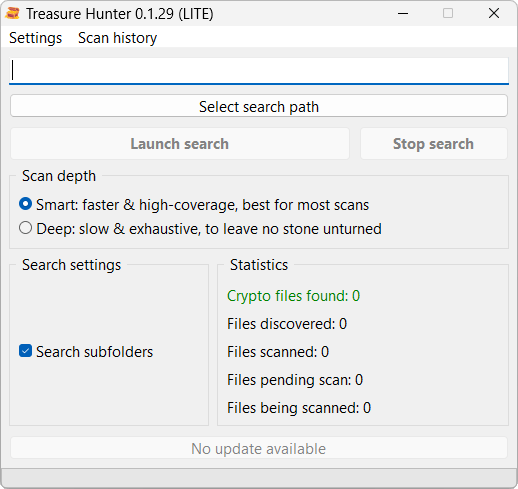
That’s where Treasure Hunter comes in! This powerful application is fully functional offline and is designed to scan storage devices and detect any file that may contain cryptocurrencies, such as wallet files and documents with private keys or seed phrases. By automating this exhaustive process, Treasure Hunter turns a digital needle-in-a-haystack problem into a streamlined search operation.
Why choose Treasure Hunter?
Most applications rely on superficial scans and search for known filenames in predefined locations. This approach quickly breaks down in real-world scenarios. Treasure Hunter goes far beyond simple filename matching by inspecting the actual contents of each file to determine whether it contains cryptocurrencies. As a result, it can uncover hidden, obscured, or corrupted wallets that traditional applications fail to detect.
Moreover, Treasure Hunter can be deployed in a completely offline environment, even when activating a paid license. By operating without Internet access, it guarantees data privacy, providing a secure solution for anyone prioritizing asset safety.
Frequently asked questions
How do I best use Treasure Hunter?
You should scan storage devices that may have stored cryptocurrencies at some point. This may include, but is not limited to:
- Your computer’s main hard drive.
- External hard drives, USB keys, SD cards, CDs, DVDs, or Blu-ray discs.
- Reconstructed filesystems from wiped or damaged drives.
Can cryptocurrencies be recovered from a reformatted, wiped, or damaged storage device?
Yes, but your mileage may vary since its original data is likely to be corrupted. Make sure to run Treasure Hunter with a deep scan to maximize your odds of a successful recovery. Follow this tutorial for more information.
Does Treasure Hunter collect any information?
By default, Treasure Hunter collects analytics to help improve the software, but this is entirely optional. You can disable this behavior at any time through the software’s settings or by going offline. Your scans will continue to work exactly the same.
If I find Bitcoins on someone else’s storage device, do they belong to me?
No. Simply finding Bitcoins does not grant ownership. Treasure Hunter is intended for the recovery of personal assets or for official use by entities with legal or judicial authorization. In compliance with our payment processing regulations, users are reminded that unauthorized access to third-party data is a criminal offense classified as “Invasion of Computer Device” under Brazilian Law 12.737/2012.